
Case Study: Emergency Department Diversion
The Problem: Emergency rooms are overused for symptoms that could be addressed through lower-cost, faster-access channels. The client wanted to reduce avoidable ER utilization by:
Guiding members to the right care option based on severity
Increasing use of telehealth, advice nurse lines, and urgent care
Reducing overall medical costs while improving the member experience
Members reported confusion about where to go, and many defaulted to ER because it felt like the “safest” option.
At the same time, the client’s existing communications were long, clinical, inconsistent across channels, and not tailored to specific symptoms or member needs.

My Role
I led the content and experience strategy from start to finish. That included designing a multi-channel decision-support flow (email, SMS, IVR, direct mail, and a landing page) and creating a simple, symptom-based triage framework to guide members to the right care. I also built the core message architecture, set content standards to streamline reviews, and developed interactive prototypes that we tested with real members.
I partnered closely with client stakeholders, care teams, operations, and vendors, driving alignment, advocating for scalable content, and keeping the strategy on track despite shifting requirements and redesign requests.
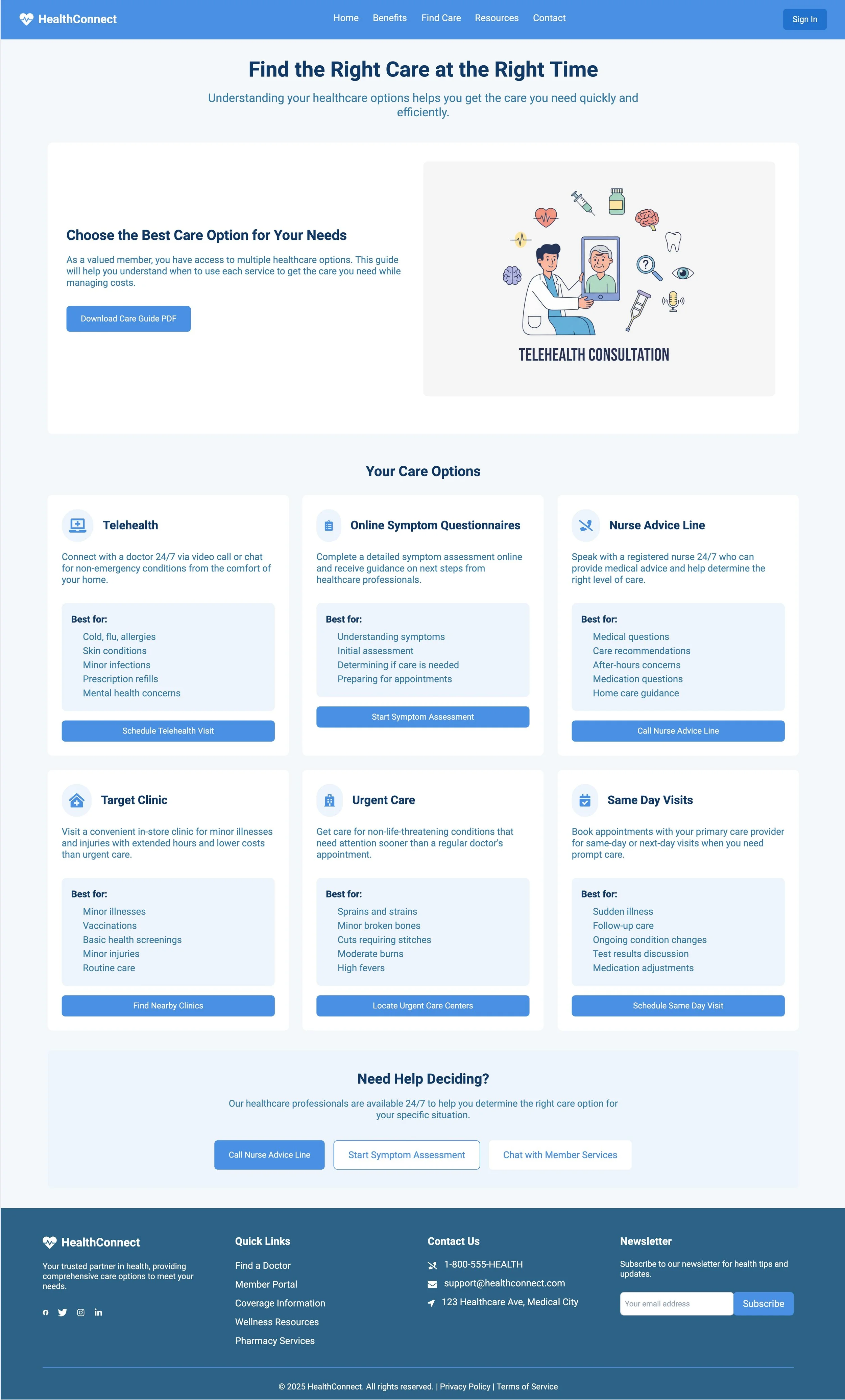
The Solution: A Clear, Symptom-Based Care Path
We created a simplified, visually guided experience that answered the core question: “Where should I go for care right now?”
Key elements included:
Triage logic grounded in real member behavior
Symptoms grouped into clear categories
Each category mapped to recommended channels (telehealth, advice nurse, urgent care, ER)
Content aligned with clinical guidance but written in plain, 6th-grade language
Consistent messaging across every touchpoint
Members were guided through:
Email series
SMS nudges
Direct mail overview
IVR routing with optional SMS follow-up
A dedicated web experience
Across all channels, the framework centered on three moves: check symptoms → choose the right care option → get help fast without defaulting to the ER.
We streamlined content, removed redundancies, and applied behavioral design techniques like priming, simplicity, and clear next-best actions.

Sample Flow

A simplified example from the flow I created:
Member clicks “I feel sick”
Presented with symptom tiles (fever, rash, cough/cold, stomach pain, etc.)
Selecting a symptom opens a care recommendation card (urgent care, Advice Nurse, telehealth)
Clear “when to go to the ER” warning indicators appear only when truly necessary
Member receives a follow-up SMS with hours, locations, or the nurse line if they abandon the flow
If they call the IVR, the same content logic is used to route them to:
Advice Nurse
Appointments
Behavioral health
ER only for red-flag symptoms

Projected Results
The program rolled out to approximately 35,000 members, and even with shifting requirements and parallel redesigns, early signals pointed toward strong member engagement and clearer care decision-making.
Member Feedback
20–30% survey completion rate (aligned with expectations)
Members described the guidance as “easy,” “fast,” and “comforting”
Increased confidence reported in choosing the right care option
Behavioral & Channel Engagement
2–4% projected movement into lower-cost channels (telehealth and advice nurse line)
High interaction with the symptom tiles and SMS follow-up links
Early trends suggested fewer members defaulting to ER for mild symptoms
Operational & Strategic Impact
Content standards expected to reduce review cycles by ~40%
The triage framework created a scalable model the client can reuse for:
seasonal illness guidance
benefits education
care-navigation improvements
Improved cross-functional alignment and reduced scope churn across channels
Navigating Challenges
Constant program redesigns (client shifted goals mid-build)
→ I re-framed deliverables into reusable modules so changes wouldn’t break the entire flow.
No standard content boundaries
→ I developed a framework that UX, content, and operations now use to stabilize future programs.
Stakeholder misalignment
→ Facilitated working sessions to re-align on scope, decision paths, and review responsibilities, reducing bottlenecks and saving weeks of back-and-forth.
Final Takeaway
This project demonstrates my ability to take a messy, multi-stakeholder healthcare initiative and turn it into a strategic, member-centered, omni-channel experience, while navigating complexity, tight timelines, and shifting requirements.
It also shows how strong content strategy can directly support cost savings, care quality, and the member experience.